
How to Write Resume Achievements Without Numbers
Published November 11, 2026 · Updated November 11, 2026 · Reading time: 8 minutes
To write resume achievements without numbers, explain what you did, the context, and a result you can support. That result might be a process people adopted, a problem you resolved, or a deliverable someone used. If you do not know the outcome, describe the finished work and its aim. Do not claim an improvement.
You can use this approach on a CV, too. Having no performance numbers is not the same as having no evidence of your work.
Loyola University Maryland's resume guidance makes the same point: outcomes can show impact even when exact numbers are missing. Your task is to find a truthful detail that helps the reader see what you did.
What makes an achievement convincing?
A responsibility tells the reader what your job involved. An achievement shows something you delivered, resolved, or changed within that job.
“Prepared onboarding materials” names an activity. “Created a troubleshooting guide that became part of the new-hire onboarding pack” names a deliverable and its adoption. Neither line needs a percentage, but the second gives the reader more to judge.
Whoever reads your application will ask:
- What did you personally do?
- What was difficult, important, or relevant about the work?
- What happened afterward, and how do you know?
A detail earns its place when it speaks to the role you want. Use these questions to check your writing. Each employer may judge this in its own way.
Santa Clara University's accomplishment guidance uses context, action, and result, and recommends numbers where possible. That leaves room for a specific result put into words.
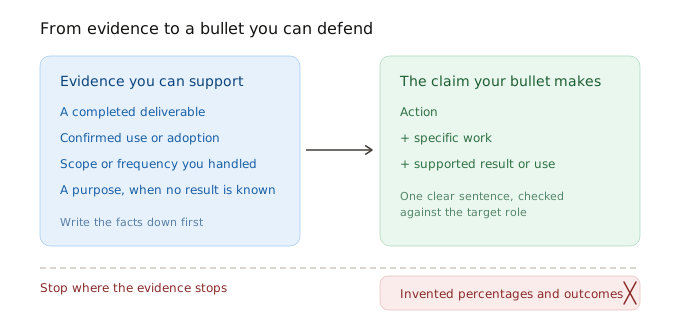
A good starting structure is action + specific work + supported result or use. Write down the facts first. Turn them into one clear sentence. Then check the sentence against the target role. If you only know the purpose, use wording such as “to support”. Do not present the goal as a result.
Start with what you actually know
Before you rewrite a bullet, make a short private note of what happened. Separate your actions from the team's actions. Separate what you saw happen from what you hoped would happen.
Good evidence can be a completed project, an approved document, or a process that colleagues adopted. Feedback you received or a decision your work informed also counts. Check records you are allowed to see, such as your own reviews or permitted project notes. Keep these notes out of the resume itself. Follow the employer's rules on extra materials, and protect anything confidential.
Use these lines to choose accurate wording:
| What you can support | What the bullet can explain | Boundary to respect |
|---|---|---|
| A measured change | The result, period, and your contribution | Do not claim the entire change if other work contributed. |
| An observed outcome | What changed, who used it, or what was accepted | Do not translate an observation into a made-up percentage. |
| A completed deliverable | What you produced and its confirmed use or status | Completion does not establish downstream savings or growth. |
| Scope or frequency | What you handled and how regularly | Workload alone does not establish improved performance. |
| A purpose with no known result | What you did and what it was intended to support | Do not present the intended benefit as an achieved outcome. |
A scope statement still helps. “Coordinated weekly handovers between support and engineering” gives more context than “handled communications.” Do not turn it into a claim that teamwork improved unless you can explain what changed.
Turn your evidence into a resume bullet
This illustrative scenario was created to show the writing process. It is not a HireGPS customer case or an employer assessment.
An operations coordinator knows this:
- Supplier updates were stored across separate email threads.
- They built a shared tracker showing order status, owners, and unresolved questions.
- The operations lead used the tracker in weekly supplier meetings.
- Nobody measured time savings or delivery performance.
The original bullet is vague:
Helped improve supplier communication.
An unsupported rewrite adds a result the facts do not support:
Transformed supplier operations, cutting delays by 30%.
A defensible rewrite uses the known work and its confirmed use:
Built a shared supplier tracker covering order status, owners, and open questions; adopted by the operations lead for weekly supplier meetings.
This version shows what the candidate built and how it was used. It does not claim that the tracker reduced delays, saved money, or changed supplier performance.
Check what the same example proves for your target role
The facts stay the same when the target role changes. What changes is what you need to show. The same tracker example:
| Target role requirement | Evidence this example provides | Evidence still missing |
|---|---|---|
| Coordinate operational updates | A shared tracker, named owners, and use in recurring meetings | Whether you handled the other coordination duties in the posting |
| Negotiate supplier agreements | Familiarity with supplier information | Negotiation responsibility, decisions, or agreed terms |
| Own supplier performance | A reporting tool used by an operations lead | Your decision authority and responsibility for performance outcomes |
For a coordination role, the bullet may be relevant evidence. For negotiation or management roles, choose another experience that shows the missing duty, if you have one. Stronger wording cannot supply experience or authority you did not have.
Examples of resume achievements without metrics
The examples below are illustrative, not real applicant results. Each stronger version assumes you can support every added detail. Use them to question your own experience. Do not copy an achievement you did not perform.
Administration: show a completed change and its use
Before: Maintained office documents.
After: Consolidated onboarding forms into a version-controlled folder adopted by HR as the source for new-hire paperwork.
The evidence is the organized resource and HR's adoption. Without adoption, describe the completed folder alone.
Customer support: explain the problem you resolved
Before: Dealt with difficult customer issues.
After: Resolved a recurring billing dispute by tracing the account history and coordinating a correction with finance.
This names a problem and how it was solved. Company-wide satisfaction or account retention would need its own evidence.
Software engineering: identify the technical contribution
Before: Worked on software quality.
After: Added regression tests for a previously untested payment-failure path and integrated them into the release pipeline.
The completed technical change is clear. A claim about fewer production incidents would need its own evidence.
Marketing: distinguish delivery from commercial impact
Before: Supported product launches.
After: Developed launch messaging and a sales FAQ approved by product and sales leads for use in customer briefings.
Approval shows the status of the work. Its real use and commercial results are still open questions.
Early career: use relevant project evidence
Before: Completed a group research project.
After: Analyzed interview transcripts for a university research project and presented recurring service-access barriers in the team's final report.
It is specific, and it does not imply that the findings changed public policy. Present the work as a university project, not as a job. The University of Toronto Mississauga's resume guidance says projects and paid and unpaid experience can all belong on a resume.
Describe your share of a team result
A team achievement can go on your resume when you state your part accurately. Taking part in the work is not the same as owning the whole outcome.
Suppose a team launched a customer portal. You wrote the help content. Colleagues designed and built the product. An accurate example bullet would be:
Wrote and reviewed the help content for a customer portal launch, working with support and product teams to check instructions against the live workflows.
“Led the customer portal launch” would claim a broader role. “Drove customer adoption” would add an outcome that writing the content alone does not support.
The University of North Georgia's accomplishment guidance says to explain how you contributed and to use wording that shares credit where it fits. You can be exact about your role without making it sound small.
Choose verbs that match your authority: analyzed, drafted, tested, coordinated, implemented, or led. Use “led” when you can explain what you directed and which decisions were yours.
When is it reasonable to add a number?
Use a number when it is true, relevant, and one you are allowed to share. Scope numbers help even without performance results: sites supported, people trained, or reports delivered.
An estimate needs a basis. If permitted records support a workload range, call it approximate. Be ready to explain the period and the math. Do not scale one busy day you remember across a year and call that your typical workload.
Take extra care with improvement claims. “Saved time” needs evidence that the work took less time afterward. “Reduced errors” needs a basis for comparing errors. Calling a percentage “approximate” does not make it a claim you can support when you know neither the starting point nor the result.
If you cannot rebuild the figure with confidence, keep the specific line in words. You can still describe what you built, resolved, or delivered.
What if you know the purpose but not the outcome?
Say what you did, and keep the goal separate from the result. For example:
Created a handover checklist to support consistent case transfers between shifts.
This states the purpose. It does not claim that consistency improved. If you know the checklist was adopted, say so. If you do not know its use or effects, stop at the finished work.
A resume can hold relevant duties and deliverables next to achievements. Forcing every line into an outcome claim can make it less accurate. Lead with your strongest evidence, then use short context to explain the rest of the role.
The UK National Careers Service recommends tailoring a CV to the opportunity. That is a good final filter: keep details that show what the posting asks for. Skip showy claims that have nothing to do with the job.
Check that you can explain every claim
Read each revised bullet as if an interviewer had asked, “Tell me exactly what happened.” You should be able to explain what you did, the situation, the outcome you claimed, and what other people did.
Then check the wording against the facts. Did “prepared” become “led”? Did a planned benefit become a delivered result? Did the team's work become your own achievement? Where the wording has moved past the evidence, restore the accurate version.
For broader context, see what recruiters look for in a resume. To see how your resume presents your experience for a target role, start a free HireGPS analysis.
A note on how HireGPS reads this advice: its No Measurable Impact check looks for figures in your three most recent roles. A truthful scope figure, such as “supported 3 sites” or “trained 12 new hires,” clears that check; qualitative evidence such as “adopted by the operations lead” does not. Without any figure, HireGPS will still flag the gap as a recruiter risk that tends to become an interview question. The worked analysis example shows how a flagged risk reads in a full analysis.
Read the explanations alongside the score. HireGPS's simulated Shortlist, Hold, or Reject assessment is guidance from its rules, not an employer's decision. Its FAQ explains the model's limitations, including that it has not been validated against hiring outcomes. Clearer qualitative evidence does not guarantee a higher tool score or an interview.
Your next revision can be small. Pick one vague bullet, recover the facts behind it, and state the most relevant work you can support. A clear account of real work gives you something solid to discuss when the interview gets there.
Sources
- Loyola University Maryland, Career Center: resume guidance: outcomes can demonstrate impact even when exact numerical data is unavailable.
- Santa Clara University, Career Center: accomplishment statements: context, action and result, with quantification where possible.
- University of Toronto Mississauga, Careers: what is a resume: projects and paid and unpaid experience as possible resume components.
- University of North Georgia, Career Services: accomplishment statements: explaining how you contributed, with collaborative wording where appropriate.
- UK National Careers Service: CV sections: tailoring a CV to the opportunity.
Read next:
- What Is a Good ATS Score? How a Resume Score Works
- Resume Red Flags That Become Interview Questions
- HireGPS Analysis Example: Score 58, Two Risks, Next Steps
See which recruiter risks your resume triggers at hiregps.app: free, deterministic, and explained.
Check your own CV against the same rules.
Start your free analysis →Free account. 3 analyses a month. No card needed.