
HireGPS Analysis Example: Score 58, Two Risks, Next Steps
Published July 22, 2026 · Updated September 23, 2026 · Reading time: 6 minutes
Contents
- The First Thing Most Candidates Notice
- The Full Score Breakdown
- The Two Active Risks
- What One Revision Changed
- What This Analysis Shows That Generic Feedback Cannot
The First Thing Most Candidates Notice
Most candidates, on receiving a HireGPS analysis for the first time, have a version of the same reaction: they submit what feels like a strong resume, and the score comes back lower than expected. The gap between self-assessment and independent scoring is not a technical quirk. You know what your resume means because you wrote it and you know the career behind it. The analysis reads only what is on the page.
Illustrative example. The resume in this walkthrough is invented; there is no real candidate and no real outcome behind it. The analysis is not invented: every score, risk, and action below is what the HireGPS engine returned when that resume was run through it on September 23, 2026.
The resume belongs to a senior software engineer with about six years of experience, most recently in payments infrastructure, applying for a Senior Software Engineer role in North American tech. The overall score was 58: Hold. Not a rejection, and not a shortlist.
The Full Score Breakdown
Category Scores at a Glance
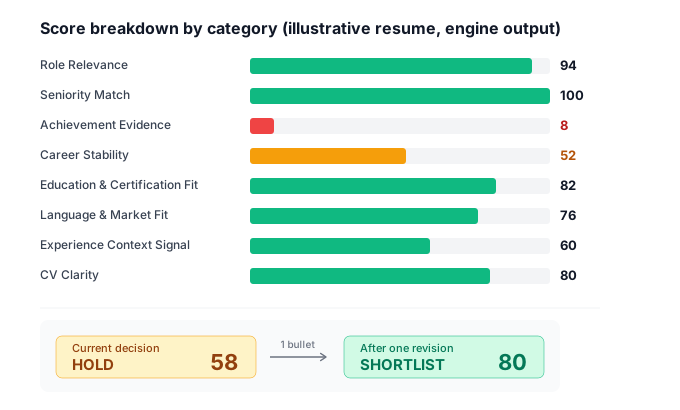
HireGPS evaluates every resume across eight weighted categories. This one scored: Role Relevance 94, Seniority Match 100, Achievement Evidence 8, Career Stability 52, Education & Certification Fit 82, Language & Market Fit 76, Experience Context Signal 60, CV Clarity 80. Overall score: 58.
⚡ Score context: Two categories are the constraint: Achievement Evidence (8) and Career Stability (52). The other six are solid, and two sit at or near the top of the scale. This is what a deterministic analysis makes visible: not "your resume needs work," but "these two dimensions are holding it back."
Achievement Evidence at 8 is the striking number. Every bullet in the three most recent roles describes duties. The only figure anywhere on the resume, a test-coverage improvement, sits in an older role, outside the window the engine reads for recent impact. Career Stability at 52 comes from the dates: four of the five roles lasted about a year.
What 58 Means in Practice
Hold means the score sits between this persona's Hold line (50.6) and its Shortlist line (76.8). Those lines belong to this persona: a senior engineering role in North American tech, applying to a specific posting. They vary by role, seniority, industry, and region. They are initial product assumptions and have not yet been validated against real hiring outcomes (how the engine works).
The 58 is not a verdict. It is a diagnosis with two named causes.
The Two Active Risks
No Measurable Impact — HIGH
What fires it: no quantified achievement in the three most recent roles. The engine does not single out one bullet; it counts. Here is what it was counting:
- Senior Software Engineer: "Led backend development for the payments platform. Worked with product and design on new checkout features. Responsible for code reviews and mentoring engineers."
- Software Engineer: "Built services for card transaction processing. Participated in on-call rotation and incident response."
- Software Engineer: "Developed internal APIs for the merchant dashboard. Collaborated with the data team on reporting."
None of these says what happened as a result. The engine's explanation, word for word:
Recruiters in Tech & Media use quantified outcomes as the primary signal of real impact. At Senior level, generic responsibility descriptions are not persuasive. The absence of numbers signals either that impact was not measured or that it was not significant enough to cite.
And its action:
Add metrics to at least the top 3 most recent roles. Focus on the metric type your target function values: technical. If exact numbers are confidential, use relative figures ('reduced time-to-hire by 30%') or scaled ranges ('budget accountability of $1M–$5M').
A rewrite of the first bullet, assuming these facts are true: "Led backend development for the payments platform; cut checkout API p95 latency from 900ms to 240ms and moved 2.1 million monthly transactions onto the new service. Mentored 4 engineers." The numbers have to be real. HireGPS's own rewrite recommendations work the same way: where a figure is missing, they leave a marked gap for you to fill instead of inventing one.
Chronic Short Tenure — HIGH
What fires it: three or more roles under 18 months, with an average tenure under 18 months. This resume has four roles of about a year each, none of them explained.
The engine's explanation:
In Tech & Media, average tenure below 18 months across multiple roles signals instability risk. Recruiters at Senior level weigh the cost of early attrition heavily — particularly for roles requiring relationship-building and ramp-up time.
And its action:
For each short-tenure role, add a brief explanation: contract ended, company acquired, org restructured, or deliberate move. If the short tenures were contract roles, group them visually or label them clearly. Unexplained short tenures are riskier than explained ones.
Do it: a short label answers the question a recruiter would otherwise ask, at no cost to truthfulness. But be clear about what it does not do. HireGPS measures tenure by duration and does not read labels, so Chronic Short Tenure stays in the analysis and the score does not move. The label is written for the person reading, not for the number.
What One Revision Changed
The analysis lists its actions by severity. Here both risks are HIGH, so both sit at the top. To see what a revision actually does, we ran the same resume through the engine a second time with one change: the rewritten first bullet above, and nothing else.
The result, from the engine:
These are two runs of the engine on the same invented resume. They are not a real user's before-and-after, and they say nothing about what happens after an application is sent.
- No Measurable Impact: cleared
- Achievement Evidence: 8 → 72
- Overall score: 58 → 80
- Decision: Hold → Shortlist
- Chronic Short Tenure: still active, because nothing about the dates changed
Two things are worth taking from this. First, the action asked for metrics in the three most recent roles, and one quantified bullet was enough to clear this risk. The action is a standing recommendation, not a computed minimum, and a resume with three strong bullets is still the better document. Second, not every fix moves the number. The tenure labels change nothing in the score, and because the published score is a whole number, a small real improvement can leave it where it was. The risk list is the better signal: a risk that is no longer listed has been addressed, whether or not the number moved (more on reading the score).
⚡ Pro tip: Change one thing, rerun, and check which risk dropped off the list. Isolating changes shows you what each revision did.
What This Analysis Shows That Generic Feedback Cannot
Generic resume feedback, whether from a career coach, an informal recruiter review, or a broad scoring tool, tends to be directional. "Your bullets need to be more achievement-focused" is correct, and not specific enough to act on efficiently.
This analysis named two risks, stated the condition behind each, and gave an action for each. The rerun showed which one a single revision cleared and which one it could not touch. That is the difference between a rating and a diagnostic instrument.
Read next:
Every number in this walkthrough came from the HireGPS engine; only the resume is invented. Your own resume will fire different risks, against a persona built for the role you target.
See which recruiter risks your resume triggers at hiregps.app — free, deterministic, and explained.